



It's generally acknowledged that the increased attention paid to customer experience innovation in business-to-consumer (B2C) markets in recent years has not been matched in business-to-business (B2B) channels and that the majority of B2B businesses are still not truly customer-centric.
But the opportunity for B2B businesses to differentiate their brands and improve profitability by delivering a superior experience to their customers is huge and, given the chilly economic headwinds we now face, arguably more urgent than ever.
Over the last few years we've learned a lot about the nuances of customer behaviour across a range of B2B projects; from reimagining the way brands support retail partners to transforming B2B ecommerce experiences. All fascinating and all good.
But we've also discovered consistencies in the needs and expectations of customers (aka people) across all of these projects - here are three common themes that any B2B business can learn from and should act on right now.
B2B customers expect functionality, content and tools that help them complete their tasks at work quickly and easily - this holds for internal customers, who complete tasks for large accounts and external customers who complete the tasks themselves. These expectations are increasingly coloured by the quality of the customer experiences available outside work - why wouldn't they be?
To meet these expectations, it's important to understand the specialist tasks that people carry out, such as specifying products, ordering them and actually using them. Engaging with people in specialist roles within large accounts helps identify and prioritise these tasks and gives clues to the needs of customers in smaller accounts, where these roles are combined.
Finally, understanding the context in which people carry out these tasks is critical to designing experiences to support them - In what environment are they completed? How often? What other pressures are people under? Think busy, hot kitchens or cold, windy building sites - think late at night when the store is closed.
There is often a misalignment between the content and tools people need to get their jobs done and the digital assets businesses make available to them, with inspirational content, expert advice, access to reusable content and simple, useful tools either lacking or inaccessible.
It's not unusual to observe people trawling through websites, blogs and videos, and using spreadsheets and calculators to get things done, either because appropriate content and tools don't exist, or are hidden behind a login wall. When this happens, there are obvious opportunities to make life easier for people in accounts of all sizes.
Realigning content priorities with those of customers, starting by repurposing existing content, creating simple task-specific tools and making these accessible to all are low-cost activities with disproportionately high impact. They can also improve organic search and help with acquisition - your competitors' customers are looking for support too.
There's no doubt that customers have high expectations around range and availability, price, quality and delivery and successful B2B businesses tend to be really good at understanding these expectations and meeting them.
But given the reality (or perception) that more than one supplier can meet these practical needs, how do customers choose between them? The answer is that people then make decisions based on purely emotional criteria - how they feel about dealing with a business.
This sheds a whole new light on things and puts us slap bang into D2C territory - if people enjoy dealing with a brand, they will choose to do so more often at the expense of other brands that aren't as enjoyable to deal with. I'm afraid it's as simple as that.
"if people enjoy dealing with a brand, they will chose to do so more often"
There are a wide range of areas to consider, as these quotes show; "They're honest with me when something goes wrong", "I feel like they listen to what I have to say", "I enjoy dealing with them" and "I'm proud to be part of their community".
So it's essential to understand how people feel - good and bad - about every aspect of the end-to-end brand experience, whether this is assisted by an internal sales agent or entirely self-service, then use this insight to prioritise action to amplify the good and address the bad.
There's more complexity in B2B businesses. Customer journeys are longer, with more people involved. Organisations can be more complex with multiple legacy systems that stymie progress, so change takes longer.
In this context and faced with a myriad of options to innovate (digital or otherwise), how can business leaders begin to decide between these initiatives? The only answer is to understand who customers are and what they need - then prioritise accordingly.
"The only answer is to understand who customers are and what they need"
The good news is though, whilst there are differences between the needs of B2B customers in different contexts, the expectations people have for digital experiences to help them get tasks done quickly and simply, for content and tools to support them and for their interactions with brands to be being enjoyable are all common - so these areas wouldn't be a bad place to start.

There's strong evidence to suggest that leaders in B2B businesses are paying more attention than ever to the customer experiences they provide across their digital channels.
This has been driven by four trends that we explored in more detail in a previous post:
For us this is a welcome departure from the established narrative, which constantly reinforces how far B2B customer experiences lag behind their B2C counterparts - suggesting somehow that digital leaders across manufacturing, wholesale and distribution just don't get it and need to get their acts together.
But the reality is very different. There's a level of sophistication in B2B ecommerce that B2C digital teams could only dream of. It's a world where personalised ranges and prices, sophisticated cross-merchandising and self-help tools, combined with unparalleled levels of customer service are the norm.
Digital leaders in B2B do get it and have actually been quite busy.
In fact, it would be easy to argue that B2B provides a far better platform for customer experience innovation then B2C, where the route to growth still involves a constant struggle to attract ever higher levels of traffic, combined with efforts to convert these visitors to customers, then retain them, when most will forever remain frustratingly anonymous or uncontactable.
Small wonder then that an increasing number of digital leaders from B2C are making the move into B2B. The combination of complexity, sophistication and ambition, with the ability to make a real difference for identifiable customers is intoxicating enough to make a switch to this emerging and rapidly growing sector very attractive.
So, if digital leaders in B2B actually do get it and have been busy delivering levels of personalisation and customer service unmatched in many B2C contexts and people from B2C are moving into the sector, why is it that so many customer experiences in B2B still don't meet customer expectations?
In our experience this is because they fail to meet the emotional - as well as the practical needs of customers, who expect experiences that are simple and enjoyable to use, need access to useful content and tools and want to feel valued, trusted and part of a community.
But the failure to understand and act on this doesn't sit with digital leaders at all, it has its roots in the organisational inertia of B2B businesses, some of which have been operating in the same way (digital channels aside) for 100 years or more. The old way of doing things has always worked.
As a consequence there has been a lack of investment in digital and it's not unusual for huge B2B ecommerce businesses to be run by very small teams, with limited development budgets at their disposal - a far cry from the levels of digital innovation and customer-centric change present in B2C today.
But talk to any of today's breed of digital leaders in B2B and you will discover they are painfully aware of any deficiencies in the customer experiences they are responsible for managing. They don't need any more research to remind them of this or to incentivise them to act.
In fact, far from being resistant to change - they are actually the change agents. They are the ones taking on and winning the argument within their organisations that - in order to flourish in the future - it's essential to become customer-centric and invest in digital as a route to do so.
And it's an important argument to win because, whilst we all agree it's essential to become customer-centric, it's harder to act on this in practice. Investing in understanding customers needs, then meeting them takes time and has to compete with projects with tangible short-term ROI benefits such as (for example) relocating a warehouse to reduce fulfilment costs.
Sometimes it's hard to keep the faith.
So, whilst there is evidence things are changing (we refer to our opening paragraph) and clear market trends driving the need for change - actually making it happen relies on the leadership, grit and determination of today's B2B digital leaders.
Click here to join "The B2B Experience" LinkedIn Group to connect and share insights with other digital leaders across manufacturing, wholesale and distribution.

By many measures it would be fair to say that the focus on customer experience in B2C digital commerce over the last 10 years hasn't been matched in the world of B2B.
But this is changing fast and B2B businesses across manufacturing, wholesale and distribution are starting to focus on digital innovation as a route to improve the experiences they provide to their customers - from acquisition to after-sales support.
So what's driving this change? Are we approaching a tipping point where the quality of the digital customer experience will become a crucial factor in the success of B2B businesses?
Here is our assessment, based on conversations with B2B Digital Leaders across Europe over the last few months.
1. The use of B2B digital channels has accelerated rapidly
The genie is out of the bottle. Restrictions on physical interactions during Covid forced customers to engage with B2B digital channels, often for the first time - so they became incredibly important almost overnight. With the pandemic (mercifully) behind us, this customer behaviour hasn't changed, so digital channels are now getting the level of focus they deserve.
2. Customers are getting younger and expectations are changing
B2B customers are getting younger and they expect customer experiences as slick as those they enjoy in civilian life. As a result, personalised digital experiences that allow customers to complete their work tasks easily and are enjoyable to use are quickly becoming the new benchmark for B2B businesses.
3. Digital has become a route to significant revenue growth
Improving the experience for existing customers to increase loyalty and share may not be enough to deliver significant revenue growth, but engaging with new audiences and creating new digital products and services that meet their needs and are aligned with their expectations most definitely can be - so that is where forward-thinking digital leaders are focusing their attention.
4. It's no longer optional - the threat of disruption looms large
And here's the killer - it's no longer optional. The increasing use of digital in B2B, changing demographics and the potential for customer experience innovation to deliver revenue growth - taken together - mean that the threat of disruption now looms large.
It's easier and more tempting than ever for customers to switch suppliers and when, as in some cases - that supplier is Amazon - the need to innovate is urgent.
The practical consequences of this aren't complicated - B2B businesses are becoming more customer-centric and setting out to "make us easy to do business with" - stepping stones on the route to creating experiences their customers love.
They are striving to understand more about their customers (existing and prospective) and what they want and expect - mapping the end-to-end experience to identify unmet practical and emotional needs they can respond to.
Finally, they are creating new digital content, products and services to meet these customers needs - experimenting and iterating as they do so to ensure they hit the mark and achieve their commercial objectives.
This is a well-trodden journey in B2C and involves the use of a proven and repeatable design-led process, so it's not exactly rocket science - but it is new to many B2B businesses and does require real commitment and investment.
However - based on our discussions with B2B Digital Leaders in 2022 - it seems that embarking upon it is no longer optional.
Click here to join "The B2B Experience" LinkedIn Group to connect and share insights with other digital leaders across manufacturing, wholesale and distribution.
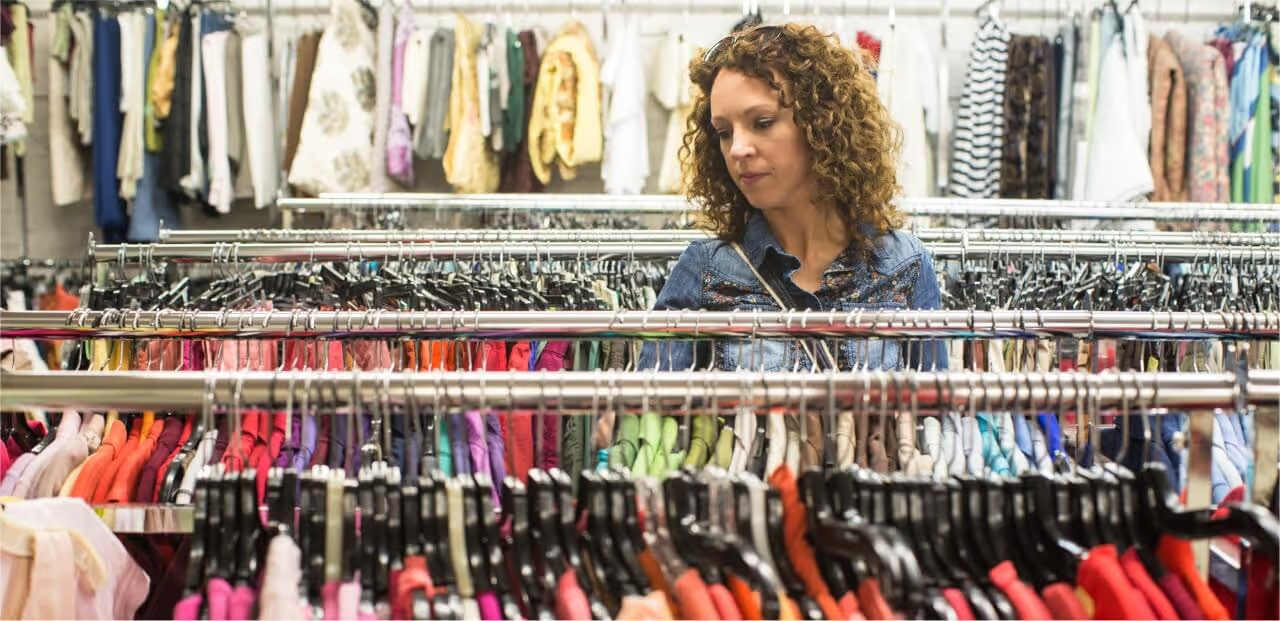
Attitudes have changed dramatically since the pandemic - customers now have motivations beyond price and quality and 72% expect companies to address their broader needs and expectations. They are willing to abandon brands that don't align with their values and pay more to those that do. [1]
Undoubtedly the biggest shift in attitudes has been towards sustainability, which is now well and truly in the mainstream consciousness - today, 79% of customers claim they are changing purchase preference based on the environmental impact, social responsibility and economic inclusiveness of their purchases. [2]
This is not the prerogative of the young - as has long been assumed - there is strong evidence that concerns for sustainability apply across geographies, age groups and income distributions. This cannot be a priority just for brands serving younger demographics. [3]
Are these expectations being dampened by the cost-of-living crisis? Well no. In fact, it's arguably accelerating the trend, according to research from EY. It found that customers battling the cost-of-living crisis are not just seeking to make more economical choices, but more sustainable ones too - 90% said they are trying not to waste food and 55% are paying more attention to the environmental impact of what they purchase.[4]
For real-world evidence of this, take the significant increase in charity shop sales reported last week- 22% higher than pre-pandemic trading, with some retail shops trading at more than double. What could demonstrate a more powerful and symbiotic link between the search for value and sustainable choices than engaging in the circular economy in support of good causes?
Whilst we all hope this crisis will soon pass, all the evidence shows that the shift in customer attitudes will not. In fact it will continue to accelerate.
This means brands (D2C or B2B) need to look beyond the needs and expectations of their customers from a transactional perspective to understand the bigger picture - their broader set of attitudes and values. Only then can they begin to ensure their brand experience aligns to these values - towards sustainability and others.
Brands that get this right will win, because the potential rewards are enormous. Truly customer-centric brands now typically outperform user-experience focused brands by 600% or more in terms of year-on-year growth. [2]
What's more, aligning with customer values is a shortcut to the Holy Grail of brand marketing, because it is so effective in forging deeper, more enduring connections with customers. Almost two-thirds (64%) of consumers say buying sustainable products makes them feel happy, while 52% feel an emotional connection with brands that deliver on sustainability. [2]
This has not gone unnoticed. Recent research from Accenture found that 77% of CEOs are planning to fundamentally change the way their businesses engage and interact with customers as they seek renewed growth, improved durability and greater relevance. [5]
As Accenture's report put it:
"Brands today are facing intense pressure to stand for something bigger than the products and services they sell. This demand for purpose has been growing for years but has been accelerated by recent world events."
So, how can brands close the gap between the what customers expect and the reality of the brand experiences they provide? The answer is to become customer-obsessed. For a customer-obsessed brand:
The biggest challenge for brands seeking to adapt is to do so at pace. There is no time to lose, and the days of year-long customer studies are gone. The sheer size of the gap between customer expectations and experiences, plus the existential threat that comes with getting it wrong, means that reimagined customer experiences must be delivered on vastly accelerated timescales. What's more, they must be right first time.
The good news is that there are logical, repeatable processes that brands can employ to do just that - taking the guesswork out of experience innovation and delivering at pace.
References
[1] Accenture: The Reimagined Customer - 2022
[2] Cap Gemini, How sustainability is fundamentally changing consumer perceptions - 2022
[3] LEK - Consumer Sustainability Survey 2022
[4] https://www.just-style.com/news/uk-clothing-retailers-must-offer-value-for-cash-strapped-consumers/
[5] Accenture: The Business of Experience
Need Help?
You can read more about our services here - and, if you're looking for innovative ways to validate a digital product or service, get in touch to find out more about how we can help.

With Europe in the grips of a cost of living crisis, fuel prices and inflation still rising, this year's peak trading season will be like no other. In everyday customer research, we are already seeing customer sentiment and behaviour starting to shift markedly.
Across a range of research projects, the message from customers has been consistent and growing louder:
We can't predict overall spend patterns of course, but these shifting priorities mean this year's peak will be more competitive than ever and there will inevitably be winners and losers, simply because we are once again entering unknown territory.
It is, however, still not too late to take steps to increase the chances that your brand will emerge as one of the winners - relatively simple, low effort optimisation activities can have a significant impact when you're likely to need it the most.
This is not about big projects like adding payment methods or delivery options, but how your brand is presented to customers. From campaigns and tone of voice through to basic usability improvements there's still time to make a big difference - and it all starts with the customer.
So, with around nine weeks to go, here are three things you can still do to optimise for peak trading:
The simple fact is that around 60% of all ecom purchases are now carried out on mobile[i]. Meanwhile, plenty of brands are still concerned that their responsive mobile experience simply doesn't yet live up to customer expectations.
Whilst there's no time for a full overhaul of your mobile site, a focus on meeting the basic needs and expectations of customers can still deliver significant upsides. Key areas to focus on here are likely to be:
There's still no substitute for conducting moderated 121 usability sessions with real customers to answer these questions and identify opportunities quickly. If you haven't put customers in front of your site for a while, you may well be surprised how much their attitudes have changed.
The legacy of pandemic is that this can now be done remotely, saving time and effort with no loss of quality, so there's no excuse for delay. Use your analytics data to identify and explore relevant micro-conversions and these will help you prioritise what you've found.
The aim should be to create a package of improvements that can be implemented in time to make a difference for peak, from simple copy updates to changing layouts and interactions that can be implemented and measured using A/B testing tools.
With consumers feeling the pinch, facing an uncertain Christmas period and concerned about rising prices this winter, tone of voice will be crucial.
From email content to campaigns and checkout messaging - the entire customer journey in fact - it is crucial that the brand tone of voice hits the right notes at a time when it is all too easy to unintentionally seem insensitive.
To give an extreme (and very unlikely) example, an email urging customers to 'enjoy a bumper Christmas' this year wouldn't land well with the vast majority of consumers.
Meanwhile messages more in tune with customer sentiment - for instance, focusing on 'magic moments' rather than big spending - may fare better, though clearly the right answer for one brand may be totally wrong for another.
Most brands will already be well down the road when it comes to campaign and promotional content, but that doesn't mean it's too late to make tweaks that could make all the difference.
Again, the first step is to understand customer responses to your tone of voice through customer research - and, as with usability testing, rapid, remote research can be just as valuable as in-person focus groups. Find out how your customers respond to your tone of voice in the current context, listen to their feedback and, if necessary, adapt your content accordingly.
The thought of scrapping a long planned peak trading creative would strike fear into any brand - abandoning that work is simply not going to happen. But again, that doesn't mean your existing campaign creative can't be optimised to better reflect the current reality of customer sentiment. After all, you only get one chance to make a first impression.
Here, it is important to recognise that we are living through a time of almost unprecedented uncertainty. So, using customer research and testing to understand how well your creative - from imagery, themes, messages and content - resonates with customers' right now, and making changes, if necessary, seems a sensible precaution.
History is no guide
The simple truth is brands cannot rely on insight from peak seasons of the past to understand likely performance this year - we are in uncharted territory. The only people who can tell you how customers will respond to usability issues, tone of voice and creative this year are customers themselves, so it's essential to engage with them.
The most likely winners this peak season will be those that listen to customers and adapt accordingly. They will use rapid customer research to identify quick wins across usability, tone of voice and creativity - to take a little of the uncertainty out of peak trading and ensure they have done all they can to adapt to changing customer sentiment this Christmas.
[i] https://www.statista.com/statistics/612872/mobile-e-commerce-transactions-europe/

We are delighted to have been appointed by Charles Tyrwhitt to help them deliver revenue growth through customer experience optimisation.
Following the appointment, we assessed the performance of the Charles Tyrwhitt website, using moderated usability testing, expert reviews and data analysis to identify improvements to the customer experience on both mobile and desktop devices.
Our team worked closely with the in-house UX team to prioritise improvement opportunities and will now support the A/B testing of alternatives, allowing the business to make step-changes in performance.
Alex Buckingham at Charles Tyrwhitt said: "We selected Biglight as our customer experience optimisation partner because they demonstrated a strong understanding of our business objectives, their significant experience in the fashion and retail sector, and because we felt they would be able to help us achieve our goals quickly and support us, where needed, as we move forwards. Also, we felt that Chris and his team were a great cultural fit with us."
Take a look at our case studies for more on our current and past projects. For more information on how UX can increase conversion rates or how to optimise your customer journey to increase revenue, get in touch.


