


"Show me one example that it works well. If it works well, I'm with you, show me the money."
Jorge Vacca's career has centred on helping organisations turn ambitious growth strategies into practical commercial execution. Starting in logistics with DHL, he quickly earned leadership opportunities by spotting untapped opportunities, building cross-functional support and moving faster than traditional corporate processes often allow. His early experiences taught him the value of empowerment, trust and decisive action, lessons that have shaped his approach ever since.
After leading business development, acquisitions and integration programmes across Europe, Jorge moved into entrepreneurship, launching a business that exposed him first-hand to the challenges of ecommerce, platform selection and customer experience design. The experience gave him a deep understanding of why digital initiatives fail, how underinvestment can become costly, and the importance of aligning technology decisions to business strategy.
His next chapter at Philips focused on growth and transformation, helping regional markets adopt new digital capabilities, ecommerce models and emerging technologies. Through pilots, experimentation and customer-led thinking, Jorge developed a repeatable approach to driving organisational change while proving commercial value along the way.
At Kimberly-Clark, he applied these lessons to the B2B environment, where success depends not only on technology but also on trust, relationships and sales enablement. His perspective brings together B2B digital transformation strategies, customer experience transformation case studies and practical change management principles that help organisations move from ambition to execution.
Synopsis
This episode explores why successful B2B transformation is rarely about technology alone. Jorge explains what B2B customers expect today, why sales teams remain the engine of growth, and how leaders can overcome organisational change barriers through action, experimentation and stakeholder alignment. The discussion provides practical insights on scaling digital transformation in B2B, proving value quickly and building momentum for long-term change.
Topics covered
Why execution matters more than perfect strategy
Building trust and empowerment inside large organisations
Lessons from entrepreneurship and ecommerce failures
Using pilots to reduce risk and accelerate transformation
The differences between B2C and B2B digital transformation
Why sales teams remain central to B2B growth
Overcoming resistance to change through evidence and results
Aligning technology investment with business strategy
Key moments
Jorge's early leadership experiences during DHL integrations
Learning that empowerment drives faster execution and growth
The costly ecommerce mistakes that shaped his digital thinking
How Philips used pilot programmes to prove transformation value
Delivering six times higher conversion through customer-led innovation
Why trust is the foundation of successful B2B customer journeys
The distinction between knowing what to do and knowing how to do it
The engine of growth in B2B is your sales team
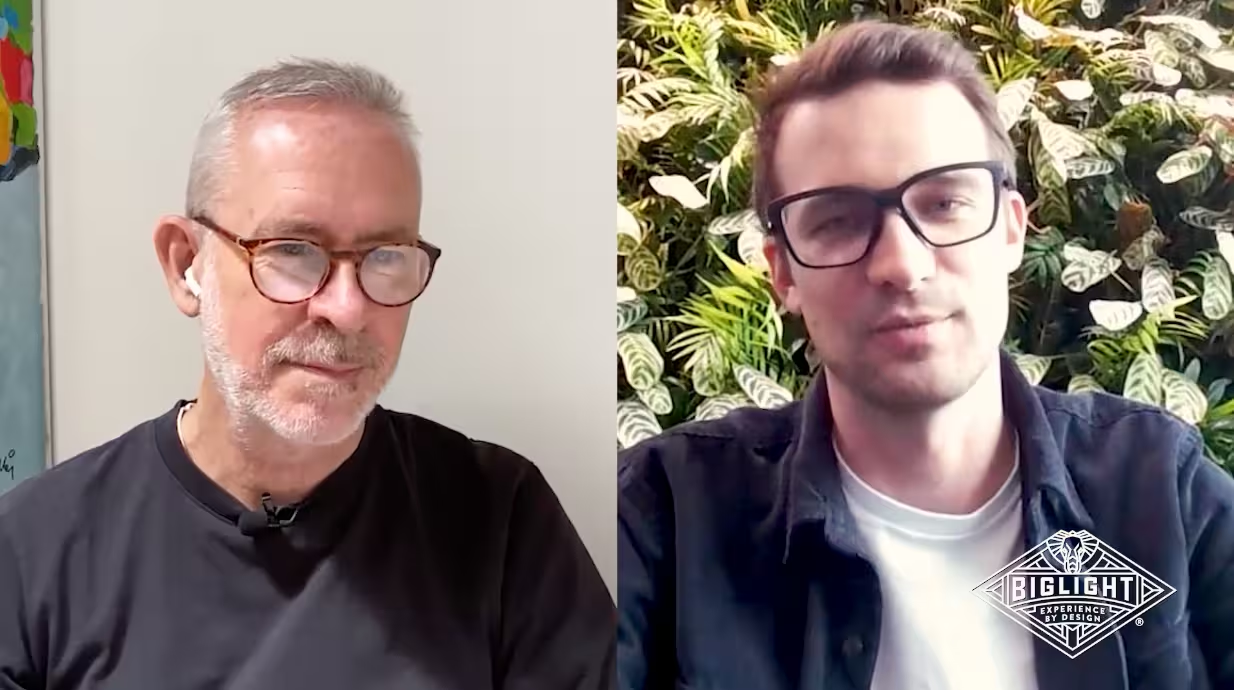
In this episode, Ev Garde, Head of Marketing at Hilti GB, explains how the business creates value beyond the product by combining tools, software and services to solve customer problems.
He shares practical B2B customer experience insights on turning customer feedback into innovation, building trust through direct relationships and designing solutions around outcomes rather than products. The conversation explores B2B digital transformation strategies, from subscription services and IoT-enabled asset management to using AI for operational efficiency and reducing admin for customer-facing teams.
Tune in for a practical discussion on customer-led innovation, service-driven growth and scaling digital transformation in B2B.

Laura Sabatini has built her career at the intersection of data, customer behaviour and commercial performance. Now leading a £500m+ ecommerce and marketing function at LKQ Euro Car Parts, she’s applying retail discipline to B2B digital transformation strategies inside a complex environment where speed, trust and scale all matter.
In this episode, Laura explores how B2C expectations are reshaping B2B and what B2B customers expect today, from simpler journeys to more seamless digital experiences. She shares practical B2B customer experience insights and explains how analytical thinking and customer understanding can unlock growth, even in the face of customer journey complexity and legacy systems.
The conversation goes beyond theory, tackling the realities behind digital transformation ROI challenges and exploring why transformation programmes fail in practice.
Tune in for a grounded look at transformation in action, with real examples and clear thinking on how to simplify, scale and bring the organisation with you.

John Kelly has spent over 25 years navigating the realities of FMCG and Food and Beverage, an environment defined by operational discipline, complex routes to market and a low tolerance for risk.
In this episode, John reflects on his 15‑year journey at Heineken, where he helped scale a B2B digital ecosystem from three pilot markets to more than 30 countries, generating over €2.5 billion in digital revenue and fundamentally reshaping how the business goes to market.
John shares honest stories from the frontline of transformation, from failed big‑bet initiatives to the power of incremental innovation, agile ways of working and building belief market by market. He explains why early pilots should focus on adoption, not ROI, how to balance annual planning with sprint‑based delivery, and why customer centricity must come before technology.
The conversation also explores practical AI use cases, including dynamic sales routing and next‑best‑action models, alongside John’s framework for scaling digital capability through distinct growth phases without moving too fast.
Grounded, pragmatic and deeply experienced, John’s perspective is a reminder that successful transformation in FMCG is rarely about disruption for its own sake, it’s about patience, proof and bringing people with you.