


"Digital transformation isn’t just a tech project, it’s a marketing and customer project".
Adam Collett’s perspective on digital transformation has been formed by his experience of working at the intersection of marketing technology and customer experience and by his role as a client of digital product design agency Biglight. Having been closely involved in digital initiatives that required collaboration between internal teams and external partners he brings a grounded view of what works in practice and what does not. His career has given him a clear appreciation of how creative UX and content contribute to real outcomes rather than surface-level change.
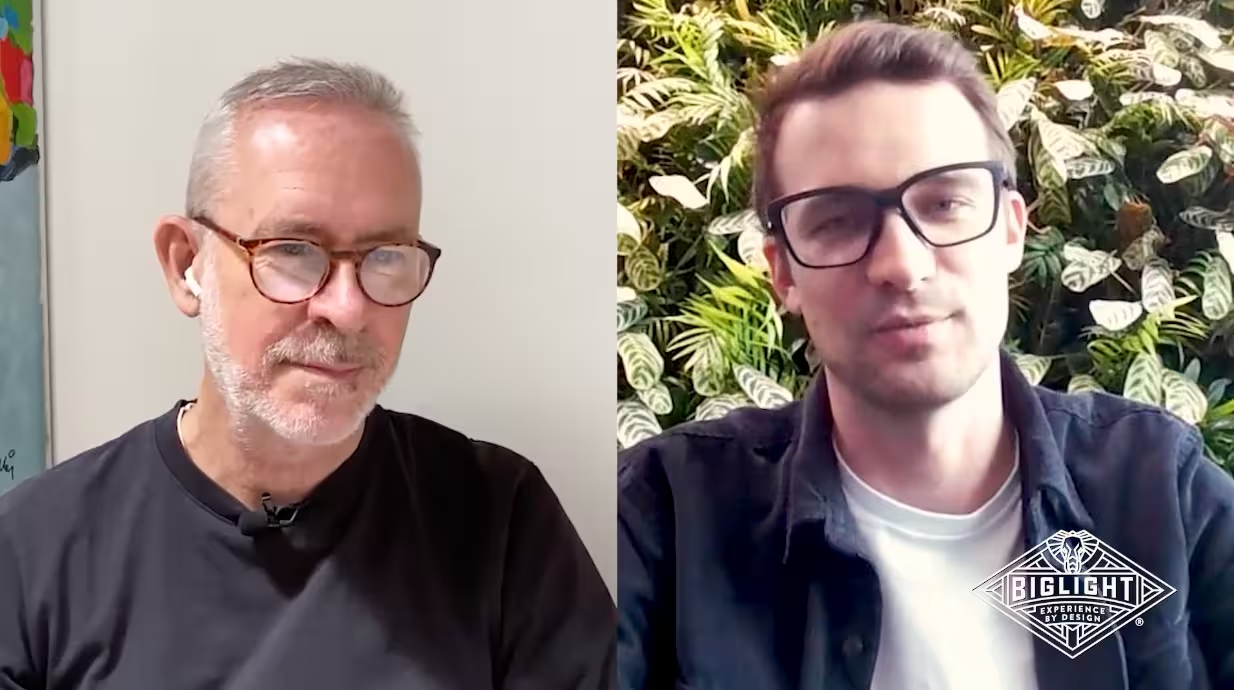
In this episode of The B2B Experience, from UK-based digital agency Biglight Adam speaks to Steve Borges about the role that creative design and user experience play in helping organisations move from ambition to execution. For him design is not about aesthetics. It is about making digital experiences that genuinely support customers in what they are trying to achieve in their day-to-day work.
A recurring theme in the episode is the idea that digital transformation often fails when organisations start with solutions rather than customers. Adam describes how easy it is for teams to focus on platforms features or campaigns without first understanding who they are designing for and what those customers actually need.
Customer insight is therefore foundational. Adam emphasises the importance of taking time to understand customer behaviours motivations and constraints before designing anything. This outside-in perspective challenges assumptions and prevents organisations from building experiences that make sense internally but fall short in reality.
Customer insight and journey mapping plays a critical role in this process. Adam explains how mapping journeys creates shared understanding across teams and provides a practical way to prioritise work. Rather than debating abstract ideas teams can see where customers struggle where friction exists and where improvement will have the greatest impact.
This journey-based approach was central to Adam’s experience working with Biglight. He speaks positively about how structured journey mapping and insight work helped align stakeholders and clarify priorities. By grounding decisions in real customer journeys the work avoided becoming subjective or driven by individual opinion.
Creative and UX design then become tools for solving specific problems rather than expressions of taste. Adam describes how thoughtful UX and UI design can remove friction reduce cognitive load and give customers confidence. Good design helps customers find what they need understand what to do next and feel reassured that they are in the right place.
Content is another key theme. Adam talks about content not as marketing output but as part of the experience. Content has a job to do. It should engage inspire and support customers as they navigate complex products services or processes. When content is clear relevant and well integrated it becomes an enabler rather than a distraction.
He highlights the importance of content that supports customers in their day-to-day roles. This might mean helping them understand options make decisions or complete tasks more efficiently. When content does this well it builds trust and reduces reliance on support or sales intervention.
Adam also reflects on the relationship between marketing and digital transformation. Too often these are treated as separate disciplines. In his experience the most effective initiatives connect them. Marketing insight informs digital design and digital experiences reinforce brand credibility and value.
Partnership is a strong thread throughout the conversation. Adam speaks about the importance of working with partners who are willing to challenge thinking and bring structure to complex problems. His experience with Biglight reinforced the value of collaboration grounded in insight rather than delivery alone.
This collaborative approach enabled incremental progress. Rather than attempting large disruptive change the work focused on making meaningful improvements step by step. Each improvement built confidence internally and improved the experience for customers.
The organisational impact of this approach extends beyond digital platforms. Clearer experiences reduce friction across teams. Better alignment improves decision-making. Confidence grows when teams can see tangible results from their efforts.
Creative design and UX are strategic tools not finishing touches. Understanding customers and mapping journeys are essential before designing solutions. Content plays a critical role in enabling and inspiring customers. And strong partnerships grounded in insight help organisations deliver meaningful digital change.
In this episode we hear how experience-led digital transformation succeeds when creative design content and customer understanding are treated as interconnected parts of the same challenge.
Topics connected to this episode
Experience design and UX in B2B digital transformation
The role of creative design in supporting customers
Customer insight and research as a foundation for design
Customer journey mapping and prioritisation
Content as part of the customer experience
Aligning marketing and digital transformation
Working with partners to deliver experience-led change
Experience design in B2B
UX and UI design for digital transformation
Customer-centred digital experiences
Customer insight and research
Customer journey mapping
Content-led engagement
Creative design in B2B
Marketing and digital transformation
Experience-led digital transformation
Why marketing principles are essential to modern B2B digital transformation
How customer insight and measurable impact drive digital growth
Lessons from working with Biglight to reshape the Brakes experience
Overcoming internal resistance and shifting from phone to digital
The growing role of content, SEO and inspiration in B2B ecommerce
Growing up in catering and discovering marketing as a career
Rebuilding the Hungry Horse proposition and seeing instant impact
Opening Brakes’ digital range and using content as an acquisition engine
How Biglight’s challenge questions reshaped the digital vision
Why customer‑led thinking now underpins transformation at Sysco GB
In this episode, Ev Garde, Head of Marketing at Hilti GB, explains how the business creates value beyond the product by combining tools, software and services to solve customer problems.
He shares practical B2B customer experience insights on turning customer feedback into innovation, building trust through direct relationships and designing solutions around outcomes rather than products. The conversation explores B2B digital transformation strategies, from subscription services and IoT-enabled asset management to using AI for operational efficiency and reducing admin for customer-facing teams.
Tune in for a practical discussion on customer-led innovation, service-driven growth and scaling digital transformation in B2B.

Jorge Vacca has spent more than two decades leading digital commerce, transformation and growth across global markets. Drawing on experience spanning DHL, Philips and Kimberly-Clark, he shares practical lessons from real-world digital transformation stories, from launching ecommerce platforms to driving large-scale organisational change.
In this episode, Jorge explores what makes B2B digital transformation strategies succeed, why execution matters more than endless planning, and how leaders can overcome resistance to digital transformation. He discusses the role of trust in B2B customer journeys, the importance of sales alignment, and why pilots are often the fastest route to proving value and gaining buy-in.
The conversation also covers digital transformation ROI challenges, sales resistance to ecommerce, AI readiness in organisations, and the realities of scaling digital transformation in B2B. Packed with practical examples, this episode offers valuable B2B customer experience insights for leaders looking to turn strategy into measurable commercial results.

Laura Sabatini has built her career at the intersection of data, customer behaviour and commercial performance. Now leading a £500m+ ecommerce and marketing function at LKQ Euro Car Parts, she’s applying retail discipline to B2B digital transformation strategies inside a complex environment where speed, trust and scale all matter.
In this episode, Laura explores how B2C expectations are reshaping B2B and what B2B customers expect today, from simpler journeys to more seamless digital experiences. She shares practical B2B customer experience insights and explains how analytical thinking and customer understanding can unlock growth, even in the face of customer journey complexity and legacy systems.
The conversation goes beyond theory, tackling the realities behind digital transformation ROI challenges and exploring why transformation programmes fail in practice.
Tune in for a grounded look at transformation in action, with real examples and clear thinking on how to simplify, scale and bring the organisation with you.