


“In a relationship‑focused business, it’s not just about efficiencies and automation.”
Chris Monery’s career began in the unforgiving world of online retail, where competition is intense, margins are thin and inefficiency is quickly exposed. That background shaped how he thinks about systems, execution and accountability. Moving into food wholesale brought him face to face with a very different kind of B2B industry, one built on relationships, routines and long‑standing ways of working.
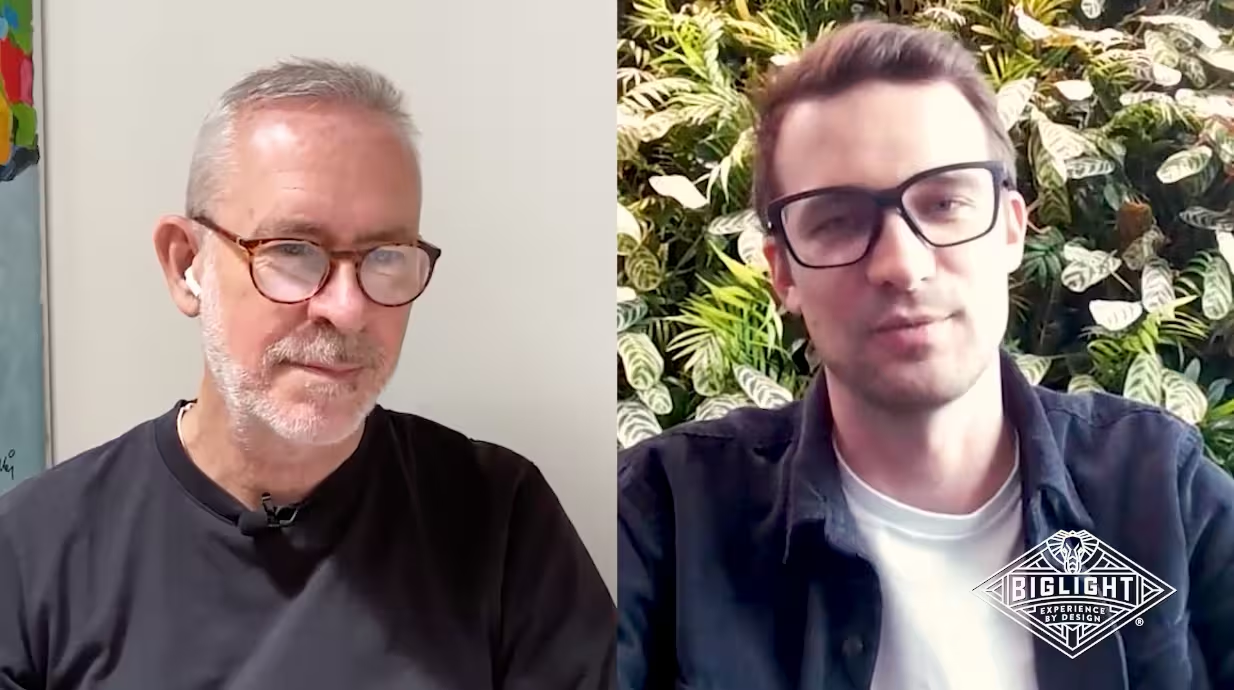
In this episode of The B2B Experience, Chris tells Steve Borges what happens when a digital mindset meets a relationship‑led business. He reflects on the shock of entering an industry where technology adoption was limited, inefficiency could persist and workarounds had become normalised rather than questioned.
A central theme in the episode is inefficiency and how it becomes embedded in protected markets. Chris explains how businesses can continue to perform commercially without strong systems, reliable data or consistent processes. Over time this creates waste, fragility and hidden risk, even when everything appears to be “ticking over”.
Chris describes how doing the fundamentals properly became the real opportunity. Instead of chasing disruption, he focused on understanding how work actually happened day to day. This meant staying close to customers, suppliers and operations, and designing systems that reflected reality rather than theory.
The conversation explores the role of technology in enabling better execution. Chris shares how building ERP, sales tools and forecasting models in‑house allowed the business to remove friction, stabilise operations and improve availability. For him, technology only delivers value when it supports people rather than forcing them to work around it.
Leadership behaviour is another key theme. Chris argues that leaders who understand the work earn trust and see problems earlier. Getting involved, asking questions and observing firsthand creates insight that dashboards and reports often miss. Respect for people follows naturally when leaders understand the challenges they face.
Chris also challenges common assumptions about transformation. He questions the overuse of the term “digital transformation” and the tendency to prioritise rollout over reliability. Systems that don’t crash, processes people trust and tools that work consistently matter more than grand programmes or slogans.
The episode also looks ahead to the role of data and forecasting in reducing waste and improving outcomes across the supply chain. Chris explains how better prediction can support availability, lower costs and improve customer experience without undermining relationships.
This episode offers a grounded and practical view of transformation in B2B. It shows how combining digital discipline with relationships and execution creates progress that lasts. When organisations focus on how work really happens and improve it step by step, change becomes both achievable and sustainable.
Key topics covered in this episode
Digital discipline in relationship‑led B2B industries
Why inefficiency persists in protected markets
Doing the fundamentals properly before chasing disruption
Building systems that reflect how work actually happens
Leadership through proximity to customers and operations
Technology as an enabler of execution rather than a goal
Forecasting demand and availability in complex supply chains
Topics connected to this episode
Digital transformation in traditional B2B sectors
Operational efficiency and systems thinking
Leadership in relationship‑driven businesses
From instinct‑led to data‑led decision making
Building trust through reliable systems
Reducing waste through better forecasting
Experience‑led change in B2B
Topics covered
Bringing digital discipline into a relationship‑led B2B industry
Why inefficiency can persist in protected markets
Moving from instinct and workarounds to systems and data
Building technology in‑house when off‑the‑shelf tools fall short
Balancing automation, execution and human relationships
Leadership lessons from staying close to the work
Forecasting, availability and reducing waste in complex supply chains
Key moments
Why food wholesale has been slow to adopt technology
Chris’s perspective on entering a low‑tech, relationship‑driven market from digital
The moment he realised “doing the fundamentals properly” was the real opportunity
Building ERP, sales tools and forecasting models from scratch
How systems stability directly changed sales performance
Why understanding the work firsthand makes leaders better problem‑solvers
In this episode, Ev Garde, Head of Marketing at Hilti GB, explains how the business creates value beyond the product by combining tools, software and services to solve customer problems.
He shares practical B2B customer experience insights on turning customer feedback into innovation, building trust through direct relationships and designing solutions around outcomes rather than products. The conversation explores B2B digital transformation strategies, from subscription services and IoT-enabled asset management to using AI for operational efficiency and reducing admin for customer-facing teams.
Tune in for a practical discussion on customer-led innovation, service-driven growth and scaling digital transformation in B2B.

Jorge Vacca has spent more than two decades leading digital commerce, transformation and growth across global markets. Drawing on experience spanning DHL, Philips and Kimberly-Clark, he shares practical lessons from real-world digital transformation stories, from launching ecommerce platforms to driving large-scale organisational change.
In this episode, Jorge explores what makes B2B digital transformation strategies succeed, why execution matters more than endless planning, and how leaders can overcome resistance to digital transformation. He discusses the role of trust in B2B customer journeys, the importance of sales alignment, and why pilots are often the fastest route to proving value and gaining buy-in.
The conversation also covers digital transformation ROI challenges, sales resistance to ecommerce, AI readiness in organisations, and the realities of scaling digital transformation in B2B. Packed with practical examples, this episode offers valuable B2B customer experience insights for leaders looking to turn strategy into measurable commercial results.

Laura Sabatini has built her career at the intersection of data, customer behaviour and commercial performance. Now leading a £500m+ ecommerce and marketing function at LKQ Euro Car Parts, she’s applying retail discipline to B2B digital transformation strategies inside a complex environment where speed, trust and scale all matter.
In this episode, Laura explores how B2C expectations are reshaping B2B and what B2B customers expect today, from simpler journeys to more seamless digital experiences. She shares practical B2B customer experience insights and explains how analytical thinking and customer understanding can unlock growth, even in the face of customer journey complexity and legacy systems.
The conversation goes beyond theory, tackling the realities behind digital transformation ROI challenges and exploring why transformation programmes fail in practice.
Tune in for a grounded look at transformation in action, with real examples and clear thinking on how to simplify, scale and bring the organisation with you.