


"I think we need to really use business evolution as opposed to transformation".
Franck Chenet brings a distinctly long-term perspective to B2B ecommerce shaped by both geography and timing. Originating in France, he completed a degree in American business before moving to Canada, where he became involved in ecommerce in its early days. Having worked through multiple waves of digital change over several decades, his career has given him a front-row view of how platforms evolve, how organisations mature and why fundamentals like customer needs, execution and data foundations consistently matter more than hype.
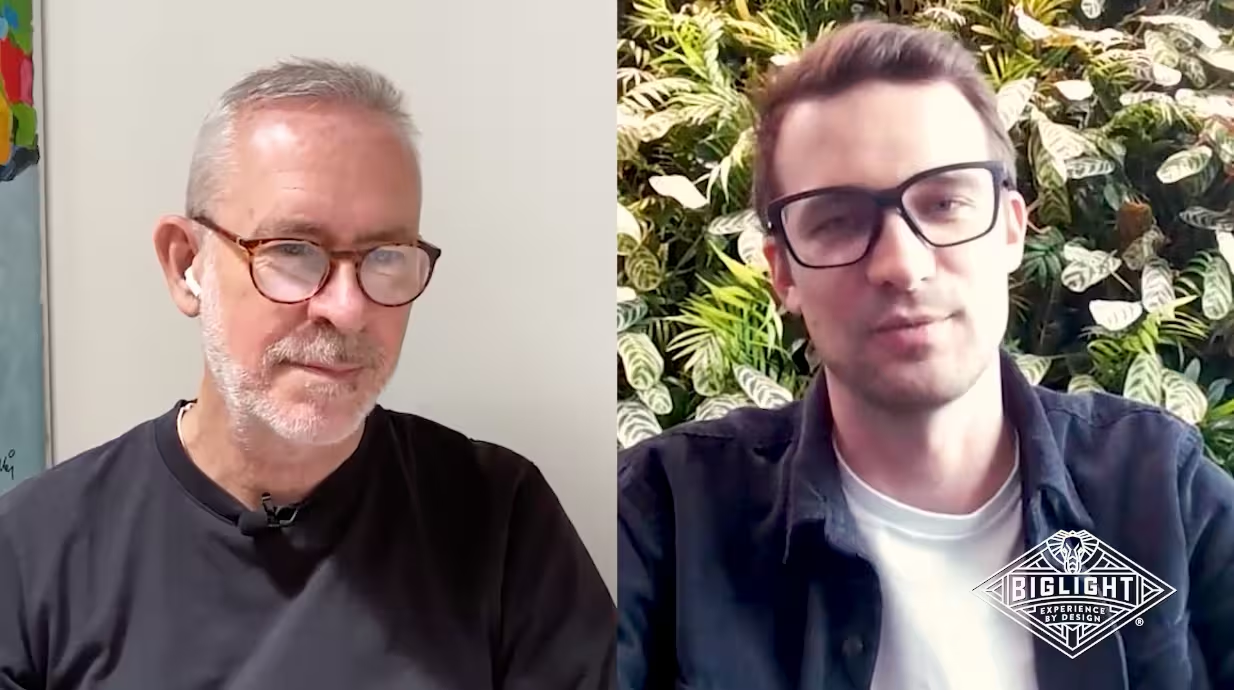
What stands out in this episode of The B2B Experience | from Biglight is Franck’s clarity about what really matters. Speaking to Steve Borges, Co-founder of leading B2B experience design agency Biglight, he reminds us that, while technologies change rapidly the fundamentals of B2B ecommerce success remain remarkably consistent. Organisations that focus on customer needs execution and data maturity tend to progress. Those that chase hype often struggle.
Ecommerce as business evolution not transformation
Franck challenges the language that often surrounds digital initiatives. He is sceptical of big-bang transformation programmes and instead frames ecommerce as business evolution. In his experience progress comes from steady improvement rather than radical reinvention.
He observes that many B2B organisations feel pressure to replicate consumer giants or adopt the latest platforms without asking whether those approaches fit their customers or operating model. Not every business needs to be Amazon. What matters is delivering value in ways that make sense for the market you serve.
This perspective shifts the focus away from technology choices and towards organisational maturity. Ecommerce success depends less on tools and more on readiness discipline and clarity of purpose.
Starting with customer needs and market reality
A central theme in Franck’s thinking is the importance of starting with customer needs. Before building features or selecting platforms organisations need to understand what customers actually expect from a digital channel.
Franck emphasises listening to the market and benchmarking competitors. This is not about copying others but about understanding where expectations are being set. Customers do not compare your ecommerce experience only to other B2B sites. They compare it to the best digital experiences they encounter anywhere.
Sales teams play a crucial role in this process. Franck repeatedly highlights the value of co-building ecommerce capabilities with sales because they are closest to customers and understand real objections needs and workarounds. This outside-in insight provides a far stronger foundation than internal assumptions.
Designing the right B2B ecommerce experience
When Franck talks about experience he is pragmatic rather than abstract. He focuses on the everyday realities of B2B ecommerce: customer portals My Account functionality self-service access to documents and clear product information.
For many customers the value of ecommerce lies not in flashy features but in convenience. Being able to download invoices check delivery slips reorder quickly or access technical documentation removes friction from daily work. These capabilities are often more valuable than advanced personalisation or complex configurators.
Franck also notes the importance of content. A B2B ecommerce site is not just an ordering system. It is a communication channel that can support education reassurance and decision-making through blogs guides and premium content.
Launching with an edge not perfection
Another consistent message is the danger of waiting for perfection. Franck advises organisations to launch with a clear competitive edge rather than an exhaustive feature set.
Test and learn approaches allow teams to validate assumptions quickly and build momentum. Early wins matter because they create internal confidence and external credibility. Perfection is the enemy of good especially in environments where customer expectations continue to evolve.
This incremental mindset aligns with experience-led digital transformation. Progress is achieved through sequencing prioritisation and learning rather than comprehensive upfront design.
Continuous improvement through outside-in feedback
Franck is a strong advocate of continuous improvement. Ecommerce is not a one-time project but an ongoing capability that requires regular input and iteration.
He describes the value of formal feedback loops often involving sales teams who can bring customer insight back into the organisation. Committees or working groups focused on improvement help ensure that ecommerce continues to reflect real needs rather than internal convenience.
This outside-in approach prevents stagnation. It also helps manage customer expectations by showing that feedback leads to visible change over time.
Data foundations before personalisation
One of Franck’s most pointed observations relates to data. He is cautious about claims of hyper-personalisation and advanced targeting when underlying data foundations are weak.
Effective ecommerce depends on reliable CRM data clear customer profiles and an understanding of transactional behavioural and contextual signals. Without this foundation personalisation becomes noise rather than value.
Franck argues for a more grounded approach. Focus first on data quality governance and integration. Only then does contextual communication become meaningful. This emphasis on fundamentals reflects his broader view that maturity matters more than ambition.
What B2B leaders can take from this conversation
Several practical lessons emerge from Franck Chenet’s perspective.
First B2B ecommerce should be treated as business evolution not a one-off transformation. Steady progress outperforms radical resets.
Second customer needs must come first. Listening to customers and co-building with sales provides a far stronger foundation than internal assumptions.
Third experience fundamentals matter. Portals self-service content and usability deliver real value when done well.
Fourth continuous improvement is essential. Ecommerce capabilities must evolve through feedback and iteration.
Finally data foundations matter more than hype. Strong governance and quality enable meaningful personalisation and communication.
Together these lessons offer a grounded and realistic view of how B2B ecommerce maturity develops over time.
How this episode connects to key B2B transformation themes
This episode aligns most strongly with data technology and digital maturity in B2B by emphasising readiness foundations and long-term capability building. It also connects to customer-centred B2B customer experience through its focus on understanding needs usability and expectations.
This episode strongly supports customer insight and opportunity identification experience design and UX excellence customer feedback and continuous improvement incremental experience-led transformation and data foundations for ecommerce.
It underpins the importance of B2B ecommerce strategy customer portals and self-service journey mapping and content-led ecommerce communication.
Topics related to this episode
B2B ecommerce maturity and evolution
Understanding customer needs in B2B
Customer portals and self-service experiences
Continuous improvement in ecommerce
Data foundations and contextual communication
B2B ecommerce strategy
Customer journey mapping for B2B ecommerce
B2B customer portals
Data governance in B2B ecommerce
Experience-led digital transformation
Why B2B customer experience must prioritise ease and meaningful work
Overcoming resistance by involving teams early and listening actively
Using customer interviews and feedback loops to shape digital requirements
How empathy and design thinking support adoption
Turning complex B2B processes into clear, valuable experiences
Moving from early online banking to B2B manufacturing
Launching track‑and‑trace based on direct customer demand
Using customer insight to counter internal scepticism
Workshops, demos and co‑creation to rebuild trust
Supporting teams through the “valley” of change
In this episode, Ev Garde, Head of Marketing at Hilti GB, explains how the business creates value beyond the product by combining tools, software and services to solve customer problems.
He shares practical B2B customer experience insights on turning customer feedback into innovation, building trust through direct relationships and designing solutions around outcomes rather than products. The conversation explores B2B digital transformation strategies, from subscription services and IoT-enabled asset management to using AI for operational efficiency and reducing admin for customer-facing teams.
Tune in for a practical discussion on customer-led innovation, service-driven growth and scaling digital transformation in B2B.

Jorge Vacca has spent more than two decades leading digital commerce, transformation and growth across global markets. Drawing on experience spanning DHL, Philips and Kimberly-Clark, he shares practical lessons from real-world digital transformation stories, from launching ecommerce platforms to driving large-scale organisational change.
In this episode, Jorge explores what makes B2B digital transformation strategies succeed, why execution matters more than endless planning, and how leaders can overcome resistance to digital transformation. He discusses the role of trust in B2B customer journeys, the importance of sales alignment, and why pilots are often the fastest route to proving value and gaining buy-in.
The conversation also covers digital transformation ROI challenges, sales resistance to ecommerce, AI readiness in organisations, and the realities of scaling digital transformation in B2B. Packed with practical examples, this episode offers valuable B2B customer experience insights for leaders looking to turn strategy into measurable commercial results.

Laura Sabatini has built her career at the intersection of data, customer behaviour and commercial performance. Now leading a £500m+ ecommerce and marketing function at LKQ Euro Car Parts, she’s applying retail discipline to B2B digital transformation strategies inside a complex environment where speed, trust and scale all matter.
In this episode, Laura explores how B2C expectations are reshaping B2B and what B2B customers expect today, from simpler journeys to more seamless digital experiences. She shares practical B2B customer experience insights and explains how analytical thinking and customer understanding can unlock growth, even in the face of customer journey complexity and legacy systems.
The conversation goes beyond theory, tackling the realities behind digital transformation ROI challenges and exploring why transformation programmes fail in practice.
Tune in for a grounded look at transformation in action, with real examples and clear thinking on how to simplify, scale and bring the organisation with you.