


"You've got to work differently and you've got to have more empathy".
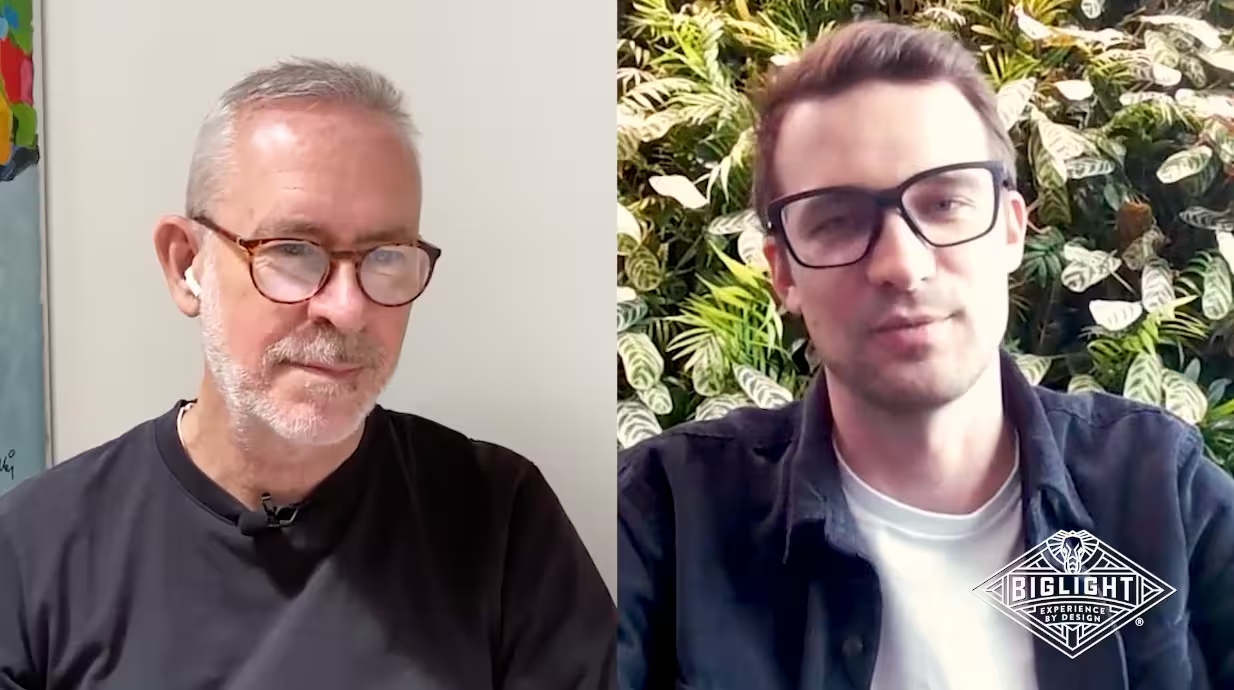
Tanja Tschech’s conversation on The B2B Experience from Biglight, specialists in B2B digital transformation, explores a theme that is often talked about in abstract terms but rarely examined in practical detail. Empathy. Rather than presenting it as a soft leadership trait or a cultural nice-to-have Tanja frames empathy as a working capability that helps B2B organisations align people make better decisions and deliver stronger experiences.
Throughout the episode she returns to a consistent observation telling Steve Borges that many B2B challenges are not caused by lack of intelligence data or intent. They are caused by people seeing the world from different positions and never fully understanding each other’s perspectives. Empathy becomes the mechanism that allows organisations to close that gap.
Tanja Tschech’s career has been shaped by a consistent focus on people rather than systems. With a background spanning organisational development, transformation, and leadership roles inside large B2B organisations, she has spent years working at the intersection of strategy, culture, and execution. Growing up and building her career across different environments gave her an early sensitivity to how individuals experience change, which later became central to her work helping organisations move forward without losing their human core.
Why B2B organisations struggle to align around customers
Tanja begins by describing how complex B2B organisations naturally fragment. Different teams focus on different priorities. Sales sees urgency and relationships. Marketing sees positioning and messaging. Product teams see roadmaps and constraints. Leadership sees targets and delivery pressure.
Key topics covered in this episode
Empathy as a foundation for customer insight
Understanding customer and stakeholder needs
Aligning teams around customer experience
Human-centred experience design
Turning feedback into action
Related topics connected to this episode
Customer insight in B2B
Understanding customer needs in B2B
Experience design strategy
Voice of the customer in B2B
Experience-led change in B2B
Each perspective is valid but incomplete. Problems arise when decisions are made without shared understanding of how these views connect to real customer needs. Organisations default to rational arguments data points and internal logic but miss the human context in which customers and employees operate.
This disconnect often shows up in customer experience. Experiences are designed from inside the organisation outward rather than from the customer back in. The result is friction confusion and missed opportunities.
Empathy as a foundation for customer insight
Tanja Tschech’s perspective on empathy and alignment is shaped by a career spent working across cultures disciplines and organisational boundaries. Her upbringing and professional journey exposed her early to different ways of thinking and communicating, and she has built her career helping organisations bring people together around shared understanding.
Rather than following a linear path, Tanja’s experience spans roles where collaboration context and human connection were essential, and this has strongly influenced how she approaches customer experience leadership and organisational change today.
Tanja reframes empathy as the starting point for insight. Before organisations can generate meaningful customer insight they need to understand perspectives without immediately judging or optimising them.
Empathy in this sense is about listening carefully to customers colleagues and stakeholders and recognising why they behave as they do. It helps uncover motivations fears and constraints that are not visible in data alone.
This approach aligns directly with customer insight work. Qualitative research interviews and open conversations are ways of scaling empathy. They turn individual understanding into shared knowledge that teams can act on.
Tanja emphasises that insight is not about collecting more information. It is about creating clarity. Empathy helps organisations distinguish between what customers say what they do and why those two things sometimes diverge.
Creating shared understanding across teams
A major theme in the conversation is the role empathy plays internally. Tanja talks about bringing people together across functions and helping them see beyond their own perspective.
Shared understanding does not mean consensus on everything. It means recognising the validity of different viewpoints and using that awareness to make better decisions. When teams understand each other’s pressures and constraints collaboration becomes easier.
This alignment is critical for delivering consistent customer experience. Experiences are shaped by multiple teams. Without empathy and shared language handovers break down and decisions conflict.
Tanja’s emphasis here connects empathy directly to organisational effectiveness. It is not about being nicer. It is about reducing friction and increasing coherence.
Empathy in experience design and decision-making
Tanja’s thinking naturally extends into experience design. Designing effective experiences requires understanding not just users but the people inside the organisation who create and maintain those experiences.
Human-centred experience design depends on empathy. It helps teams prioritise what matters most to customers and avoid designing for internal convenience. It also supports better trade-off decisions when constraints are unavoidable.
By grounding design decisions in shared understanding organisations reduce rework and disagreement. Teams spend less time defending positions and more time solving real problems.
Operationalising empathy through feedback and listening
One of the risks with empathy is that it remains abstract. Tanja is clear that understanding must be supported by mechanisms that allow organisations to keep listening over time.
Customer feedback systems voice of the customer programmes and regular listening loops provide structure. They prevent organisations from relying on outdated assumptions or individual anecdotes.
These mechanisms turn empathy into an operational capability. They help teams stay connected to customer reality even as organisations scale and evolve.
Making change happen through involvement not instruction
Tanja contrasts involvement with instruction. Change imposed from the top often meets resistance because people do not feel understood. When people are involved in shaping decisions they are more likely to support outcomes even when compromises are required.
Empathy plays a key role here. It allows leaders and teams to acknowledge concerns address fears and build trust. Change becomes something people participate in rather than something done to them.
This approach supports incremental experience-led change. Progress happens through alignment learning and shared ownership rather than rigid programmes.
What B2B leaders can take from this conversation
Several practical lessons emerge from Tanja Tschech’s perspective.
First empathy is a practical tool for understanding customers and colleagues not a soft distraction from results.
Second customer insight begins with listening. Without empathy insight remains superficial.
Third shared understanding across teams is essential for delivering coherent customer experiences.
Fourth empathy supports better experience design by grounding decisions in real human needs.
Finally making change happen in B2B depends on involvement and alignment more than instruction and control.
Together these lessons position empathy as a foundation for customer insight experience design and effective execution.
How this episode connects to key B2B transformation themes
It aligns strongly with customer-centred B2B customer experience by showing how understanding people leads to better outcomes. It also connects to making change happen in B2B through its emphasis on alignment and involvement.
It strongly supports customer insight and opportunity identification experience design and UX excellence customer feedback and experience insight and incremental experience-led transformation.
The episode underpins the importance of customer insight experience strategy and organisational alignment around customer experience.
Topics related to this episode
Empathy as a foundation for customer insight
Understanding customer and stakeholder needs
Aligning teams around customer experience
Human-centred experience design
Turning feedback into action
Customer insight in B2B
Understanding customer needs in B2B
Experience design strategy
Voice of the customer in B2B
Experience-led change in B2B
Why B2B customer experience must prioritise ease and meaningful work
Overcoming resistance by involving teams early and listening actively
Using customer interviews and feedback loops to shape digital requirements
How empathy and design thinking support adoption
Turning complex B2B processes into clear, valuable experiences
Moving from early online banking to B2B manufacturing
Launching track‑and‑trace based on direct customer demand
Using customer insight to counter internal scepticism
Workshops, demos and co‑creation to rebuild trust
Supporting teams through the “valley” of change
In this episode, Ev Garde, Head of Marketing at Hilti GB, explains how the business creates value beyond the product by combining tools, software and services to solve customer problems.
He shares practical B2B customer experience insights on turning customer feedback into innovation, building trust through direct relationships and designing solutions around outcomes rather than products. The conversation explores B2B digital transformation strategies, from subscription services and IoT-enabled asset management to using AI for operational efficiency and reducing admin for customer-facing teams.
Tune in for a practical discussion on customer-led innovation, service-driven growth and scaling digital transformation in B2B.

Jorge Vacca has spent more than two decades leading digital commerce, transformation and growth across global markets. Drawing on experience spanning DHL, Philips and Kimberly-Clark, he shares practical lessons from real-world digital transformation stories, from launching ecommerce platforms to driving large-scale organisational change.
In this episode, Jorge explores what makes B2B digital transformation strategies succeed, why execution matters more than endless planning, and how leaders can overcome resistance to digital transformation. He discusses the role of trust in B2B customer journeys, the importance of sales alignment, and why pilots are often the fastest route to proving value and gaining buy-in.
The conversation also covers digital transformation ROI challenges, sales resistance to ecommerce, AI readiness in organisations, and the realities of scaling digital transformation in B2B. Packed with practical examples, this episode offers valuable B2B customer experience insights for leaders looking to turn strategy into measurable commercial results.

Laura Sabatini has built her career at the intersection of data, customer behaviour and commercial performance. Now leading a £500m+ ecommerce and marketing function at LKQ Euro Car Parts, she’s applying retail discipline to B2B digital transformation strategies inside a complex environment where speed, trust and scale all matter.
In this episode, Laura explores how B2C expectations are reshaping B2B and what B2B customers expect today, from simpler journeys to more seamless digital experiences. She shares practical B2B customer experience insights and explains how analytical thinking and customer understanding can unlock growth, even in the face of customer journey complexity and legacy systems.
The conversation goes beyond theory, tackling the realities behind digital transformation ROI challenges and exploring why transformation programmes fail in practice.
Tune in for a grounded look at transformation in action, with real examples and clear thinking on how to simplify, scale and bring the organisation with you.