


"Do your idea, just act on it. No one else has the guts nor the enthusiasm to act on your idea."
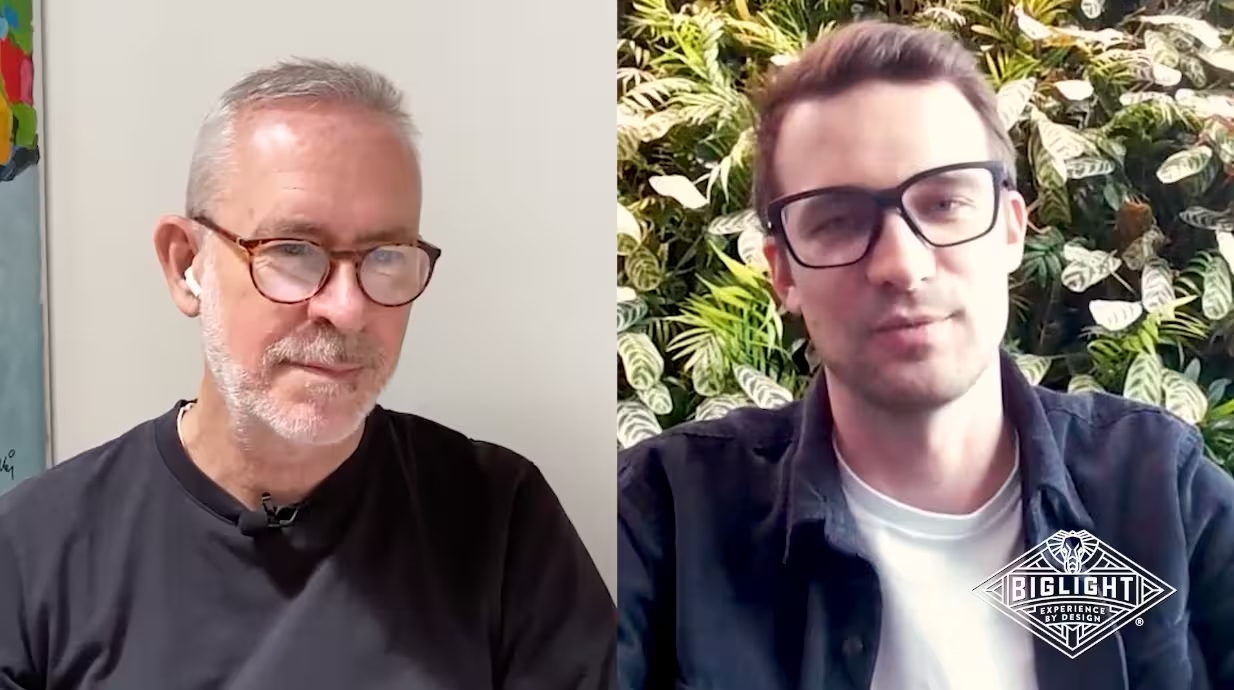
Maxim Gelmann’s career is anything but linear. He began in strategy consulting, working across FMCG, retail, healthcare and fashion. These early years gave him a grounding in business fundamentals, but more importantly, exposed him to the reality of operational complexity, customer behaviour and the importance of strategic clarity. A formative moment came when a manager handed him Blue Ocean Strategy and asked him to apply its thinking to a live project. The book became a defining lens for how he approaches innovation: look for uncontested space, create distinctiveness, and build from first principles.
A second turning point arrived far outside the corporate world. During a week at Burning Man, the festival’s “leave no trace” ethos stayed with him in ways he only recognised later. It shaped how he thought about value, impact and how people engage with sustainability. Those principles quietly informed the thinking behind Stroodles long before the idea itself was born.
The spark came when Maxim saw a short video of tubular pasta being used as a straw. Unlike previous ideas he had considered but never acted on, this one clicked. He was between roles, open to possibility, and ready to create something with genuine impact. He ordered samples, mapped out a simple supply chain and launched Stroodles. He also kept consulting in parallel to manage risk, a practical reminder that execution often requires scaffolding, not blind leaps.
From the start, he approached Stroodles not as a product business but as a brand capable of stretching into experiences, events and education. That decision shaped everything that followed. His products, edible cups, spoons, plates and bowls — act as accessible entry points into sustainability. People try them because they are fun, curious or photogenic. Only afterwards does the sustainability message land, often more powerfully than traditional messaging ever could.
His appearance on Dragon’s Den became a catalyst in unexpected ways. Maxim worked with a speaking coach who taught him how to hold an audience and tell a story without losing authenticity. Although he didn’t secure investment, the experience sharpened his confidence, deepened his understanding of media framing and expanded the reach of the Stroodles brand. It also reaffirmed that awareness, not funding, was the real prize.
Selling into hospitality and wholesale distribution has been a different kind of challenge. Restaurants and venues rarely buy directly; they buy through distributors. For Stroodles to scale, Maxim needed to create pull, customer demand, visibility and cultural momentum that made distributors want to list the product. Over time, this created a two‑way credibility exchange. Challenger brands gain legitimacy and reach by being stocked, while wholesalers gain reputational value by carrying innovative, sustainability‑led products that set them apart. It is a dynamic that speaks to a wider truth in B2B: innovation spreads fastest when both sides gain.
The conversation explores how sustainability communication has drifted into abstraction, carbon credits, certifications, back‑of‑house initiatives that customers never see. Maxim argues for a more human, experience‑led approach. Make sustainability visible. Make it enjoyable. Let the message land through behaviour, not lectures. From whipped‑cream tiramisus in edible cups to kids’ workshops, he is shifting the narrative from guilt to delight.
The episode also digs into the mindset required to act on ideas. Maxim is clear that most people overestimate the risk of sharing their concepts. In his experience, the real risk is staying silent. Ideas grow through conversation, and momentum comes from the energy you create around them. He encourages founders and leaders alike to share more, test more and worry less about competition.
What stands out most is his optimism: sustainability does not have to be heavy or moralistic. It can be playful, practical and commercially strong. For senior digital leaders in B2B, this offers a useful provocation. Sometimes the most powerful way to change behaviour is not to persuade harder, but to design experiences people talk about, remember and instinctively share.
Topics connected to this episode
Topics covered
Why storytelling and brand‑building matter more than product features
Making sustainability fun, memorable and behaviour‑changing
Blue ocean thinking in traditional B2B categories
The challenges of B2B hospitality distribution and adoption
How creative experiences unlock customer curiosity and pull‑through demand
Key moments
From consulting to Burning Man to edible tableware
The YouTube “aha moment” that sparked Stroodles
Dragons’ Den, media exposure and confidence‑building
How fun, visibility and action beat sustainability theory every time
In this episode, Ev Garde, Head of Marketing at Hilti GB, explains how the business creates value beyond the product by combining tools, software and services to solve customer problems.
He shares practical B2B customer experience insights on turning customer feedback into innovation, building trust through direct relationships and designing solutions around outcomes rather than products. The conversation explores B2B digital transformation strategies, from subscription services and IoT-enabled asset management to using AI for operational efficiency and reducing admin for customer-facing teams.
Tune in for a practical discussion on customer-led innovation, service-driven growth and scaling digital transformation in B2B.

Jorge Vacca has spent more than two decades leading digital commerce, transformation and growth across global markets. Drawing on experience spanning DHL, Philips and Kimberly-Clark, he shares practical lessons from real-world digital transformation stories, from launching ecommerce platforms to driving large-scale organisational change.
In this episode, Jorge explores what makes B2B digital transformation strategies succeed, why execution matters more than endless planning, and how leaders can overcome resistance to digital transformation. He discusses the role of trust in B2B customer journeys, the importance of sales alignment, and why pilots are often the fastest route to proving value and gaining buy-in.
The conversation also covers digital transformation ROI challenges, sales resistance to ecommerce, AI readiness in organisations, and the realities of scaling digital transformation in B2B. Packed with practical examples, this episode offers valuable B2B customer experience insights for leaders looking to turn strategy into measurable commercial results.

Laura Sabatini has built her career at the intersection of data, customer behaviour and commercial performance. Now leading a £500m+ ecommerce and marketing function at LKQ Euro Car Parts, she’s applying retail discipline to B2B digital transformation strategies inside a complex environment where speed, trust and scale all matter.
In this episode, Laura explores how B2C expectations are reshaping B2B and what B2B customers expect today, from simpler journeys to more seamless digital experiences. She shares practical B2B customer experience insights and explains how analytical thinking and customer understanding can unlock growth, even in the face of customer journey complexity and legacy systems.
The conversation goes beyond theory, tackling the realities behind digital transformation ROI challenges and exploring why transformation programmes fail in practice.
Tune in for a grounded look at transformation in action, with real examples and clear thinking on how to simplify, scale and bring the organisation with you.