


"If you don't know who your customers are, you don't know how to react".
Sergio Schiavone has built his career in wholesale apparel and footwear, working closely with sales colleagues and supporting retail buyers. Based in Italy he began his career building fan websites before rising to senior digital and leadership roles at PVH (Tommy Hilfiger) and VF Corporation, where he was responsible for providing digital products to support wholesale buying across large product ranges. That background gives him a clear understanding of how buyers actually engage with brands in real commercial contexts.
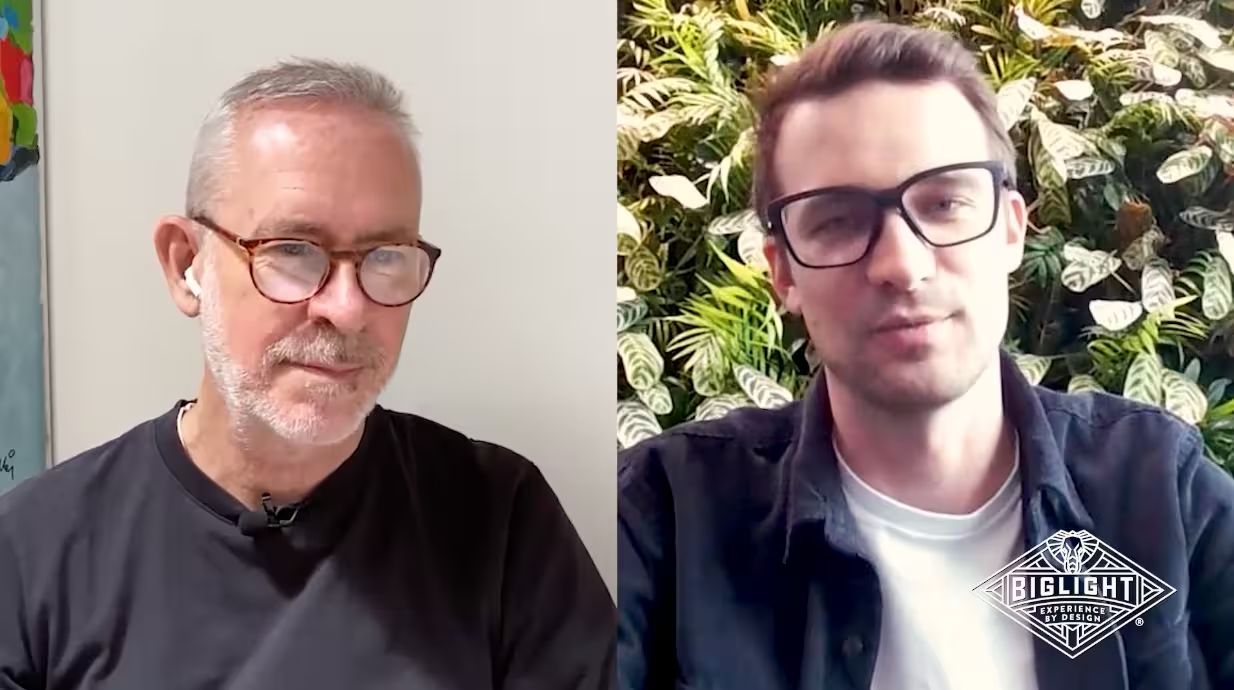
In this conversation with Steve Borges on The B2B Experience from London-based UX design agency Biglight, Sergio focuses on how digital showrooms can improve B2B buying experiences in wholesale distribution. But a central message of the episode is that digital only delivers value when it is grounded in a deep understanding of customer needs and real buying journeys.
Sergio describes the complexity of wholesale buying in apparel and footwear. Buyers manage large assortments multiple seasons and tight timelines. Traditional selling relies heavily on physical showrooms travel and samples which can introduce friction and inefficiency into the buying process.
Rather than starting with technology Sergio emphasises the importance of customer research. Understanding how buyers prepare for meetings access systems and move through the buying journey reveals where experience breaks down. Without this understanding digital risks amplifying existing problems rather than solving them.
A key insight from this project completed by Biglight, Sergio discusses is how journey mapping exposed unmet needs and pain points that were blocking progress. One of the first and most important findings was basic but critical. Customers struggled to log into the system. This single issue created friction before buyers could even begin to engage with products or ranges.
This discovery changed priorities. Instead of investing immediately in sophisticated features the organisation focused on fixing fundamentals. Improving access and removing basic blockers drove tangible action and created momentum internally. It also demonstrated the value of starting with real customer pain points rather than assumptions.
Sergio explains how customer journey mapping made these issues visible. The work to map the end-to-end journey created a shared understanding across digital commercial and sales teams. It aligned everyone around what actually mattered to buyers rather than what looked impressive on a roadmap.
This work with Biglight played an important role. Sergio talks about how the structured approach to customer research and journey mapping helped the organisation prioritise effectively. By identifying unmet needs and moments of friction the team could focus on incremental improvements that delivered immediate value.
An important part of the solution centred on the role digital showrooms could play. They helped buyers explore ranges understand products and prepare more effectively for conversations with sales teams. Digital became an enabler of better interactions rather than a distraction.
Sergio is clear that this incremental approach mattered. Progress came from fixing one problem at a time and steadily improving the experience. This avoided overwhelming the organisation and ensured that each change was grounded in real buyer needs.
Another important dimension of the conversation is sustainability. Sergio highlights how better digital experiences reduce reliance on physical samples printed materials and travel. These environmental benefits emerged naturally as a result of improving the buying journey rather than being pursued as a separate initiative.
He also reflects on the importance of alignment. Digital showrooms required collaboration across teams and clarity of purpose. Journey mapping and customer research helped create this alignment by providing a common reference point for decisions.
Throughout the episode Sergio returns to the importance of empathy for buyers. Understanding their pressures timelines and constraints is what allows digital experiences to support rather than disrupt relationships.
Customer research and journey mapping reveal unmet needs that organisations often overlook. Fixing basic pain points can unlock progress faster than launching advanced features. Incremental improvements build momentum and trust. And digital showrooms deliver the most value when they are built on a clear understanding of the customer journey.
Experience-led digital change in wholesale apparel and footwear succeeds when it starts with insight prioritises fundamentals and uses technology to support real buyer needs.
Topics connected to this episode
Customer research and journey mapping
Identifying unmet needs and pain points
Incremental experience improvements
Digital showrooms in wholesale B2B
Sustainability through better digital journeys
Customer journey mapping in B2B
Identifying customer pain points
Digital showrooms for wholesale
Experience-led digital transformation
Improving B2B buying experiences
The role of digital showrooms in wholesale strategy and B2B commerce
How customer journey mapping and personas shape effective digital selling
Overcoming sales team resistance with clarity, trust and small‑scale pilots
Sustainability and efficiency gains from reducing physical samples
Why digital evolution relies on cross‑functional alignment
How building Lufthansa’s first Italian website sparked Sergio’s digital career
His first encounter with digital showrooms and their potential
A three‑month pilot that increased sell‑in by 20%
Using self‑service and automation to improve wholesale customer experience
How working with Biglight influenced VF Corp’s wholesale portal evolution
In this episode, Ev Garde, Head of Marketing at Hilti GB, explains how the business creates value beyond the product by combining tools, software and services to solve customer problems.
He shares practical B2B customer experience insights on turning customer feedback into innovation, building trust through direct relationships and designing solutions around outcomes rather than products. The conversation explores B2B digital transformation strategies, from subscription services and IoT-enabled asset management to using AI for operational efficiency and reducing admin for customer-facing teams.
Tune in for a practical discussion on customer-led innovation, service-driven growth and scaling digital transformation in B2B.

Jorge Vacca has spent more than two decades leading digital commerce, transformation and growth across global markets. Drawing on experience spanning DHL, Philips and Kimberly-Clark, he shares practical lessons from real-world digital transformation stories, from launching ecommerce platforms to driving large-scale organisational change.
In this episode, Jorge explores what makes B2B digital transformation strategies succeed, why execution matters more than endless planning, and how leaders can overcome resistance to digital transformation. He discusses the role of trust in B2B customer journeys, the importance of sales alignment, and why pilots are often the fastest route to proving value and gaining buy-in.
The conversation also covers digital transformation ROI challenges, sales resistance to ecommerce, AI readiness in organisations, and the realities of scaling digital transformation in B2B. Packed with practical examples, this episode offers valuable B2B customer experience insights for leaders looking to turn strategy into measurable commercial results.

Laura Sabatini has built her career at the intersection of data, customer behaviour and commercial performance. Now leading a £500m+ ecommerce and marketing function at LKQ Euro Car Parts, she’s applying retail discipline to B2B digital transformation strategies inside a complex environment where speed, trust and scale all matter.
In this episode, Laura explores how B2C expectations are reshaping B2B and what B2B customers expect today, from simpler journeys to more seamless digital experiences. She shares practical B2B customer experience insights and explains how analytical thinking and customer understanding can unlock growth, even in the face of customer journey complexity and legacy systems.
The conversation goes beyond theory, tackling the realities behind digital transformation ROI challenges and exploring why transformation programmes fail in practice.
Tune in for a grounded look at transformation in action, with real examples and clear thinking on how to simplify, scale and bring the organisation with you.